

 Français
 English
● GUIDE17 JUNE 20265 MIN READ
How to succeed with an industrial project between China and Africa
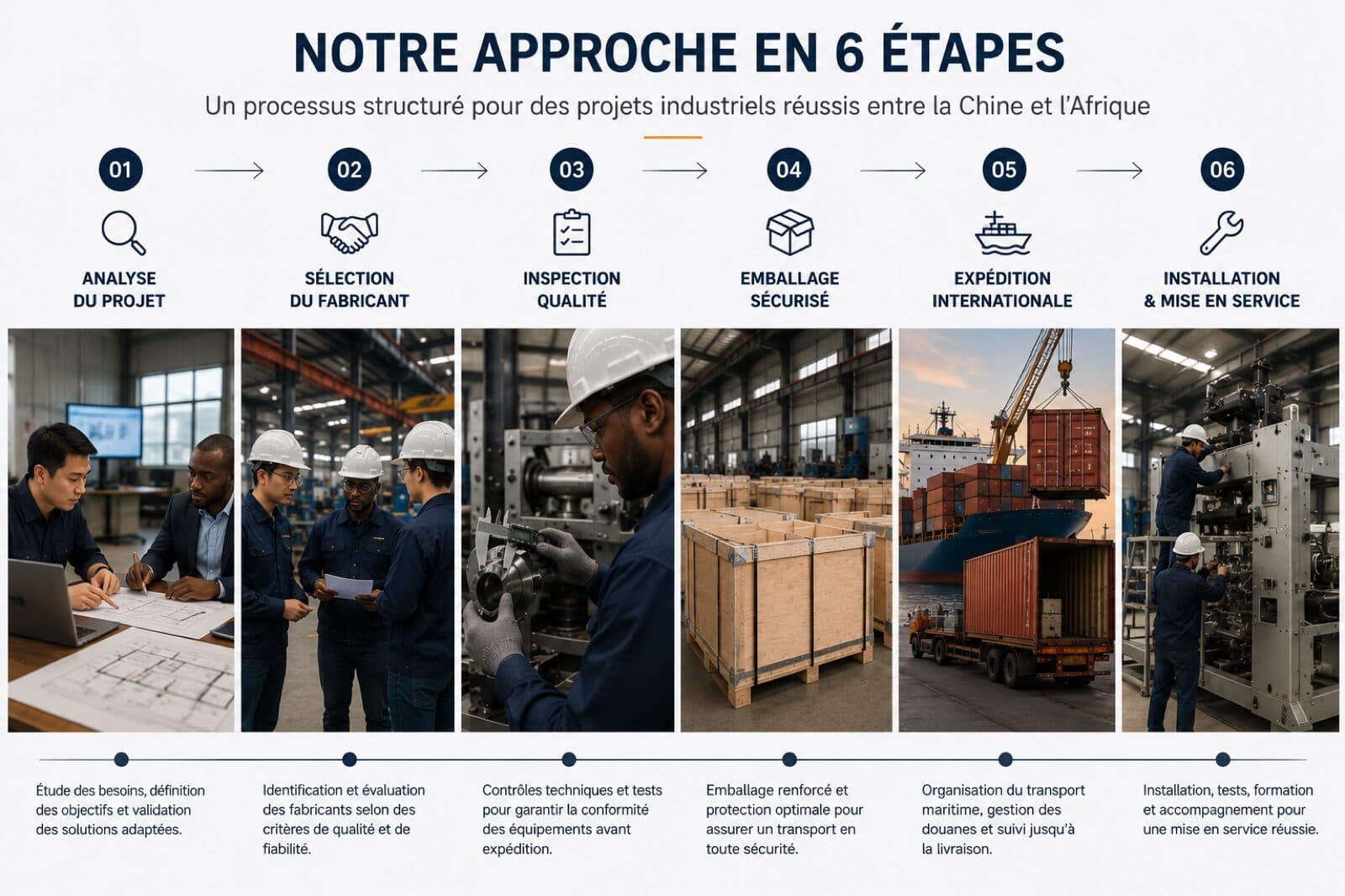
The success of an industrial project does not depend solely on the choice of a machine. It rests on rigorous preparation, a good understanding of the project's needs and full command of every stage, from equipment selection to commissioning.
Whether it is a production line, a food-processing plant, a block machine, a recycling line or laboratory equipment, every project has specific technical, logistical and financial requirements.
Clearly define the project's needs
Before any supplier search, it is essential to identify the project's objectives.
Several elements must be defined precisely:
- the desired production capacity;
- the type of raw materials used;
- the level of automation;
- installation constraints;
- future development needs.
A precise analysis avoids sizing mistakes and helps select equipment truly suited to the production goals.
Select the right manufacturer
Not all manufacturers offer the same level of quality, reliability or service.
Choosing an industrial partner must take several criteria into account:
- the manufacturer's experience;
- build quality;
- production stability;
- spare-parts availability;
- the ability to provide technical support.
A reliable supplier is not chosen on price alone, but on their ability to support the project over time.
Validate the technical specifications
Before manufacturing or shipment, all technical characteristics must be verified.
This step notably confirms:
- the machine's dimensions;
- production capacity;
- electrical voltage;
- safety standards;
- included accessories.
Rigorous validation limits errors and avoids costly modifications after delivery.
Control quality before shipment
A quality inspection verifies the equipment's compliance before it leaves the factory.
Depending on the type of machine, it can include:
- component checks;
- operating tests;
- performance verification;
- checking the packaging for international transport.
This step helps reduce technical risks and secure the investment.
Organise international logistics efficiently
The success of an industrial project also depends on the quality of its logistics organisation.
Transport, customs formalities, documentation, packaging and delivery scheduling must be coordinated to ensure the equipment is received in the best conditions.
Good anticipation avoids delays and additional costs.
Prepare installation and commissioning
The delivery of a machine marks the beginning of a new stage.
A properly prepared installation eases commissioning, reduces downtime and helps reach expected performance quickly.
Where necessary, it is also recommended to plan operator training and the availability of essential wear parts.
A global approach to secure every investment
A successful industrial project is the result of a series of technical and logistical decisions taken methodically.
By mastering every stage — from needs analysis to commissioning — it is possible to reduce risk, optimise operating costs and build a sustainable industrial business.
Whether importing industrial machinery, production lines or specialised equipment from China to Africa, a structured approach remains the best way to guarantee the project's success and the profitability of the investment.